
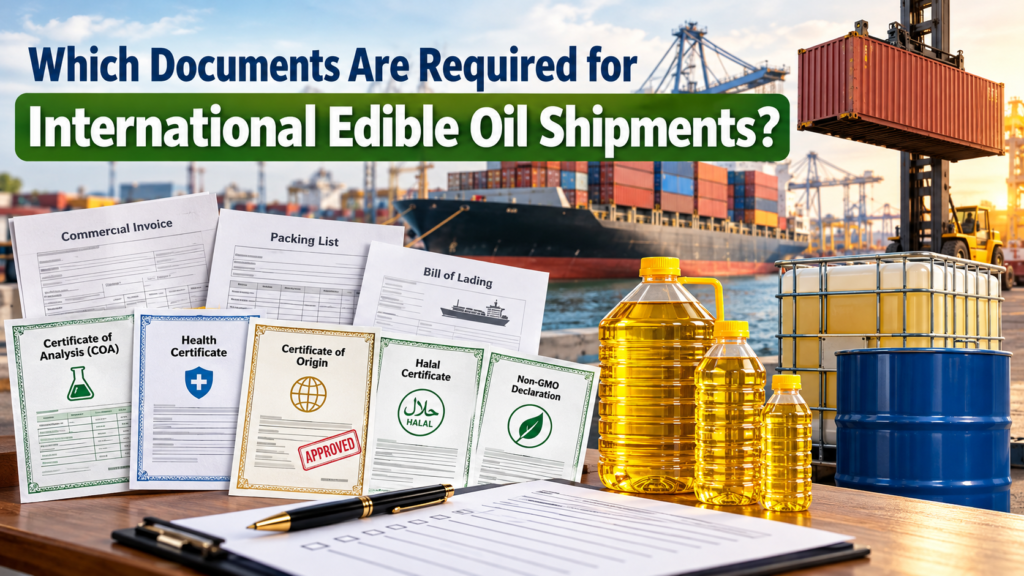
A container of sunflower oil can sit at the port for nine days because one certificate carries the wrong date. It happens more often than exporters like to admit. Edible oil shipments get closer attention than most dry cargo, since customs officers and food safety authorities both want proof of what is inside the drum, tank or flexitank.
This guide covers the paperwork that international edible oil shipments usually need, what each document is for, and where mistakes tend to slip in. If you export refined or crude oil, or buy it from overseas, the checklist below should save you a few headaches.
Start With the Commercial Documents
The commercial invoice is the base of every export file. It lists the buyer, the seller, the product description, quantity, unit price, Incoterms and payment terms. For edible oil shipments, the description matters more than people expect. “Refined sunflower oil, 1 litre PET bottles, 12 per carton” works. “Cooking oil” does not, because customs matches the wording against the HS code.
Sunflower oil sits under HS 1512, palm oil under 1511, and soybean oil under 1507.
The packing list goes alongside it. It breaks the cargo down by pallet, carton or tank, with gross and net weights. For bulk edible oil shipments, it also states the flexitank or ISO tank capacity. If the packing list says 20,000 litres and the bill of lading says 20,500, someone will ask why.
Transport Documents for Edible Oil Shipments
Ocean freight carries most edible oil shipments and runs on the bill of lading. It acts as a receipt, a contract of carriage and a document of title at once, which is why banks care about it so much.
Many buyers ask for a full set of three originals. Once trust builds up, exporters often move to a telex release or a sea waybill, which saves courier time and cost.
Small sample lots travel by air under an air waybill, and road shipments between neighbouring countries use a CMR consignment note.
- Bill of Lading (B/L) – For ocean freight shipments.
- Air Waybill (AWB) – For air cargo and sample shipments.
- CMR Consignment Note – For international road transportation.
- Sea Waybill – An alternative to an original negotiable bill of lading.
Quality Certificates for Edible Oil Shipments
This is where edible oil shipments differ from many other goods. Food regulators in the importing country want proof that the oil is safe to eat and matches the agreed specification.
1. Certificate of Analysis (COA)
The Certificate of Analysis (COA) is the most requested one. A lab tests each batch and reports free fatty acid, peroxide value, moisture, iodine value and colour. Buyers compare those numbers with the contract line by line.
For large edible oil shipments, an independent surveyor such as SGS, Intertek or Bureau Veritas often issues the COA and also supervises loading.
2. Health or Sanitary Certificate
A health or sanitary certificate comes from the food authority in the exporting country. It confirms the oil is fit for human consumption and was produced in a licensed facility. Some countries insist on it; others accept the COA alone, so ask the buyer early.
3. Certificate of Origin
The certificate of origin states where the oil was produced. Importers need it to claim reduced duty under a trade agreement, and a chamber of commerce usually issues it. Check that its date does not fall after the bill of lading date, because some buyers and banks reject it.
4. Additional Certificates Depending on Destination
Some destinations ask for extras. Middle Eastern buyers often want a Halal certificate. European importers may request a non-GMO declaration for soybean or rapeseed oil. Organic oil needs its own transaction certificate.
A phytosanitary certificate is rarely needed for refined oil, but crude or cold-pressed oils sometimes trigger the request, so confirm the rule for each country.
Customs and Regulatory Paperwork
On the exporter’s side, edible oil shipments need a shipping bill or export declaration, and in India an Importer Exporter Code (IEC) must be active.
On the importer’s side, a bill of entry is filed at the destination port, along with any import licence the country requires. Some markets add product registration on top. Nigeria, for instance, expects NAFDAC registration for packaged edible oil, and labels often need approval before the cargo lands.
Insurance deserves a mention for edible oil shipments too. Under CIF terms the seller provides a cargo insurance certificate, and with liquids the cover should include leakage and contamination.
Wooden pallets need an ISPM 15 heat-treatment stamp, and a fumigation certificate if the buyer asks for one.
- Shipping Bill or Export Declaration
- Importer Exporter Code (IEC) for Indian exporters
- Bill of Entry
- Import Licence, where applicable
- Cargo Insurance Certificate
- ISPM 15 Pallet Compliance
- Fumigation Certificate, where required
Mistakes That Delay Edible Oil Shipments
Most delays in edible oil shipments have nothing to do with missing paperwork. They come from documents that disagree with each other. A few patterns show up again and again:
- Company names or addresses spelled differently on the invoice and the bill of lading.
- A COA that carries a different batch number from the one loaded.
- The wrong HS code, which changes the duty and can trigger an inspection.
- Letter of credit terms that do not match the documents presented, even by a comma.
Banks check letter of credit documents literally. A mismatch in net weight or a missing stamp is enough for a refusal, and payment stays on hold until the discrepancy is fixed.
A Simple Way to Stay Organised
Ask the buyer for the import requirements of your edible oil shipments in writing before production starts. Build one checklist per destination country and reuse it for repeat orders.
Have a second person compare every document against the invoice before anything is sent. Work with a freight forwarder who has handled edible oil before, because tank cleaning certificates and flexitank specs are things a general forwarder may overlook.
Keep scanned copies of the full file for at least five years, since customs audits can reach back that far.
- Confirm destination-country import requirements.
- Prepare accurate commercial invoices and packing lists.
- Verify all quality certificates and batch details.
- Check HS codes and customs declarations.
- Confirm insurance coverage for liquid cargo.
- Cross-check documents before shipment.
- Maintain digital copies of export documentation.
Final Thoughts
Getting the paperwork right is mostly about checking details early. Once your documents for edible oil shipments line up with the contract, the cargo tends to clear customs without drama.
If you plan regular edible oil shipments to a new market, spend an hour with the buyer’s import rules first. It pays back at the port.