
“`html
Choosing an edible oil looks like a simple purchasing task until a batch goes wrong. A fryer that foams after two shifts, biscuits that turn rancid within eight weeks, or a sauce that separates in the warehouse can create costly production problems. Most of these issues trace back to the oil rather than the recipe. This guide explains how to match an edible oil to your process, what to ask suppliers, and where buyers most often make mistakes.
Start With Where the Edible Oil Comes From
Before comparing edible oil prices, ask where the seed was grown, where the crude oil was extracted, and which refinery finished it. A supplier who can answer all three questions without having to consult someone else often has well-organized sourcing and production processes.
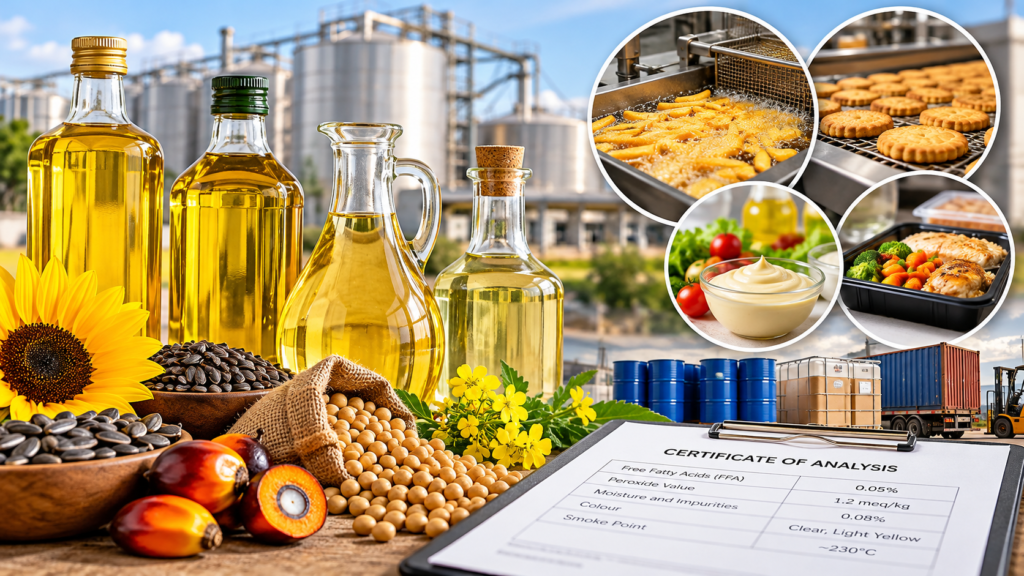
Request a certificate of analysis (COA) for every lot of edible oil rather than relying on a general product brochure. Look for ISO 22000 or FSSC 22000 certification at the refinery, and confirm that the oil meets applicable Codex Alimentarius standards or local food authority requirements.
Traceability is particularly important when a customer complaint arrives several months after dispatch. Reliable batch records help identify the source of a quality issue and support faster corrective action.
What to Check Before You Choose an Edible Oil
Evaluating an edible oil requires more than comparing the price per litre. Consider the following technical and sensory parameters before making a purchasing decision.
- Smoke point and heat stability: Refined sunflower, soybean, and palm olein oils can have smoke points around 220–230°C, depending on the specific grade and condition. Many cold-pressed oils have lower smoke points. Continuous frying operations require an oil with suitable thermal stability and a smoke point appropriate for the process.
- Fatty acid profile: Conventional sunflower oil is typically high in linoleic acid and can oxidize more rapidly under prolonged heating. High-oleic sunflower oil generally offers improved oxidative stability and may last longer in commercial frying applications.
- Free fatty acids (FFA): Fresh refined oil commonly has a low FFA level. A target of 0.05–0.10% may be appropriate for some purchasing specifications, depending on the oil and applicable standard. Higher values can indicate hydrolysis or quality deterioration.
- Peroxide value: A peroxide value below 2 meq/kg at dispatch can be a useful quality target for refined oil. Ask suppliers to explain results that exceed your agreed specification. Applicable regulatory and contractual limits should determine acceptance.
- Flavour and aroma: A neutral-tasting edible oil allows the finished product’s intended flavour to dominate. Unrefined groundnut or mustard oil may contribute distinctive aromas and flavours that are desirable in some applications but unsuitable in others.
Why Manufacturers Stay With One Supplier
Consistency matters more than a single successful delivery. If the iodine value, fatty acid profile, or other relevant characteristics vary significantly between batches, frying performance and finished-product colour may also change. Quality teams can then spend valuable time investigating problems that could have been prevented through tighter incoming-oil specifications.
A dependable edible oil supply with controlled batch-to-batch variation can save more money than a cheaper shipment that requires repeated production adjustments. Buyers should also ask whether the supplier offers quarterly pricing arrangements, maintains buffer stock, and has a contingency plan for seasonal crop-price fluctuations.
Procurement tip: Compare suppliers using the total cost of ownership, including oil consumption, production losses, product shelf life, quality testing, and delivery reliability—not just the quoted price per litre.
Common Uses: Matching Edible Oil to the Process
Different edible oils behave differently under heat, during storage, and in finished food products. Select a grade based on the manufacturing process and the characteristics required in the final product.
- Deep-fried snacks and noodles: Refined palm olein and high-oleic sunflower oil are options for commercial frying because of their potential to provide good oxidative stability during extended frying cycles.
- Bakery products and biscuits: Palm-based fats and suitable fat blends can provide the texture and crispness required in certain baked products. Sunflower or soybean oil may be suitable for cakes and softer dough formulations.
- Sauces and dressings: Refined sunflower or rapeseed oil can be suitable where a neutral flavour is required. Chilling performance and resistance to clouding should be evaluated for the intended formulation.
- Ready meals and frozen foods: Oils with appropriate oxidative stability can help maintain product quality during extended storage. The best choice depends on the formulation, processing conditions, packaging, and expected shelf life.
Snack manufacturers often prioritize frying life and thermal stability, while private-label food packers may focus more heavily on purchase price, product consistency, and shelf life. Understanding these priorities helps narrow down the most suitable oil specification.
How to Test an Edible Oil Before You Commit
Before signing a long-term supply agreement, evaluate the oil under laboratory conditions and on your own production line. A structured testing process can reduce the risk of expensive quality problems.
- Request a 5–20 kg sample taken from an actual production lot rather than a showroom bottle.
- Send the sample to an independent laboratory for free fatty acids, peroxide value, moisture, impurities, and colour testing.
- Run a pilot batch on your own production line for a representative operating shift.
- Monitor total polar compounds during frying and follow the applicable regulatory limits and internal quality specifications.
- Evaluate the finished product at 30, 60, and 90 days, where appropriate, for rancidity, flavour changes, texture, and other shelf-life indicators.
- Request a recent third-party audit report for the refinery and verify the scope and validity of the relevant food-safety certifications.
Edible Oil Packaging Options
Commercial edible oil is available in several packaging formats, and the right choice depends on order volume, storage capacity, transport arrangements, and handling requirements.
- 15 kg tins and 20-litre jerry cans: Suitable for smaller manufacturing operations, food-service businesses, and buyers who need manageable pack sizes.
- 190–200-litre drums: Common options for mid-sized production facilities with suitable handling equipment.
- Flexitanks: Often used for bulk liquid shipments, with capacities commonly around 20–24 metric tonnes depending on the equipment, payload limits, and shipping requirements.
Bulk packaging can reduce the cost per litre, but it requires appropriate receiving tanks, suitable unloading equipment, and procedures to prevent contamination. Smaller packs may cost more per unit but are often practical when testing a new supplier or managing limited storage capacity.
Edible Oil Storage Instructions
Store edible oil in sealed containers away from direct sunlight, excessive heat, moisture, and contamination. A controlled storage environment around 15–25°C may be appropriate for many refined oils, subject to the product manufacturer’s recommendations.
Heat and light accelerate oxidation, making warehouses near boilers, ovens, or other heat sources unsuitable for oil storage. Even small amounts of water or metal contamination—particularly copper and iron—can accelerate deterioration.
- Use clean stainless-steel tanks or suitable food-grade lined storage equipment.
- Keep containers properly sealed when not in use.
- Follow first-in, first-out inventory practices.
- Prevent contact with water, incompatible materials, and contaminants.
- Follow the supplier’s storage instructions and check the expiry or best-before date for the specific grade.
Sealed refined edible oil may have a shelf life of approximately 12 months, depending on its composition, packaging, processing, and storage conditions. Always confirm the declared shelf life for the product you purchase.
Typical Edible Oil Specifications to Request
The following table provides an illustrative starting point for discussing quality requirements with a supplier. Final acceptance criteria should be agreed upon for the specific oil, application, applicable standards, and contract.
| Parameter | What to Look For |
|---|---|
| Edible oil type | RBD sunflower oil, soybean oil, palm olein, or a suitable blend |
| Free fatty acids | A target of 0.10% maximum, where appropriate for the specified grade |
| Peroxide value | Below 2 meq/kg at dispatch as a proposed purchasing target |
| Moisture and impurities | A proposed maximum of 0.1%, subject to the applicable test method and specification |
| Appearance | Clear oil with a characteristic light colour and no visible sediment |
| Smoke point | Approximately 220–230°C for many suitable refined grades; verify the actual product |
| Shelf life | Approximately 12 months in the original sealed packaging, if confirmed by the manufacturer |
| Packaging | Tins, jerry cans, drums, or flexitanks, depending on order volume |
Edible Oil Export and Logistics
If you are importing edible oil, plan lead times and documentation requirements well in advance. Ocean freight, customs clearance, port congestion, and inland transportation can add several weeks to delivery, with longer delays possible during peak shipping periods.
Depending on the destination country and shipment, request and verify the following documents:
- Commercial invoice
- Packing list
- Certificate of origin
- Certificate of analysis
- Health certificate or other applicable food-safety documentation
- Shipping documents and destination-specific import permits, where required
Confirm whether the contract uses FOB or CIF Incoterms, including the named port and applicable Incoterms version. These details help establish the allocation of costs, delivery responsibilities, and risk during transportation.
For flexitank shipments, ensure that the receiving site has suitable pumps, compatible connections, trained unloading personnel, and a documented process to prevent contamination. Verify that the packaging and transport arrangements meet the requirements for the particular edible oil.
Request an Edible Oil Quote
Looking for an edible oil that fits your production line? Share your manufacturing process, monthly volume, preferred packaging, destination, and target shelf life. These details help identify a suitable grade and establish the right quality requirements.
Request a product sample and its corresponding certificate of analysis before committing to a long-term supply agreement. A short discussion about your technical requirements can help prevent costly production and quality issues later.
“`