
“`html
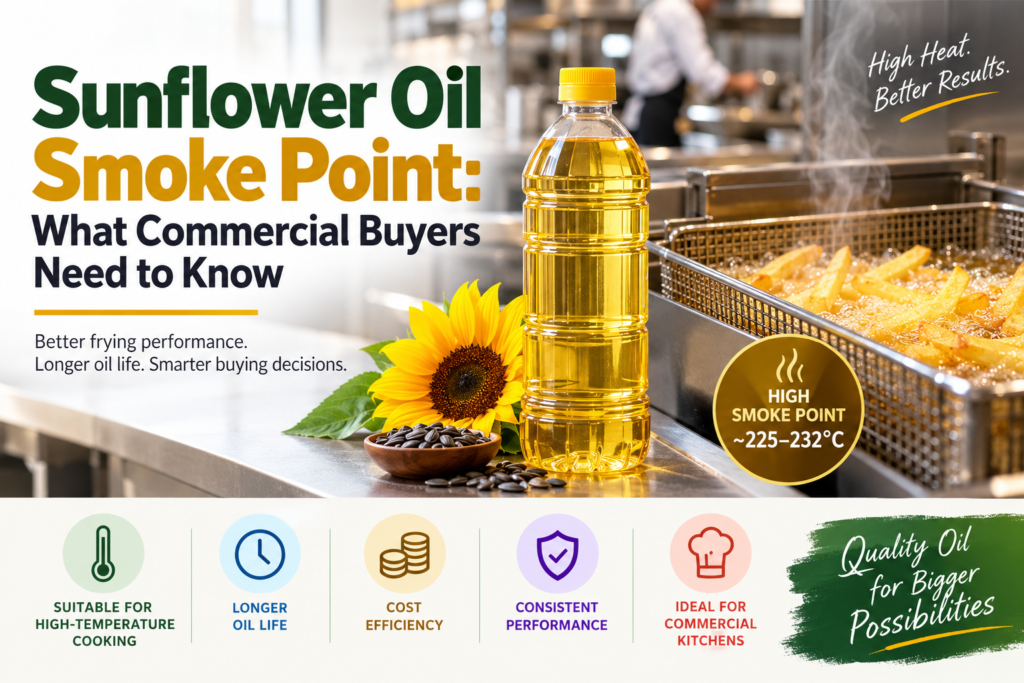
Sunflower Oil Smoke Point: What Commercial Buyers Need to Know
Walk into any commercial kitchen during a lunch rush and you’ll see fryers running nonstop for hours. Nobody’s babysitting the oil temperature dish by dish — it’s just on, hot, and working. That’s exactly the environment where sunflower oil smoke point stops being a footnote on a spec sheet and starts deciding how much oil you throw out at the end of the week.
Smoke point is simply the temperature where oil starts breaking down and visibly smoking. Cross that line and the oil doesn’t just taste worse — it starts releasing compounds that can leave food with a bitter, burnt edge. With enough repeated exposure, those breakdown products aren’t ideal for food preparation either.
Commercial Kitchen Takeaway:
For a home cook frying occasionally, smoke point may not be a major concern. For a restaurant operating fryers for several hours every day, choosing an oil with an appropriate smoke point can have a direct impact on cooking performance, oil life, and operating costs.
Refined vs. Unrefined Sunflower Oil: Not Even Close
Here’s where a lot of buyers get caught out. Not all sunflower oil behaves the same way once it hits high heat, and the gap between refined and unrefined versions can be significant.
Cold-pressed or unrefined sunflower oil can contain free fatty acids and small plant particles that remain after processing. These components can contribute to smoking at comparatively lower temperatures, making unrefined oil better suited to applications where high-temperature frying is not the primary requirement.
Refined sunflower oil undergoes additional processing that removes much of this material. As a result, refined sunflower oil can have a substantially higher smoke point, commonly around 225–232°C, depending on the product and processing specifications.
Why This Matters for Commercial Frying
- Provides greater temperature headroom during frying.
- Can be better suited to sustained high-heat cooking.
- Helps commercial kitchens maintain more consistent frying conditions.
- May support better oil utilization when combined with proper fryer management.
The Cost Side Nobody Talks About
Say your kitchen goes through a case of oil a week. Now imagine that oil breaks down a day or two faster than it should because the smoke point wasn’t where the label or specification suggested. Multiply that across every location, every fryer, and every month — suddenly you’re paying for oil you’re throwing away, not oil you’re cooking with.
Buyers don’t always connect sunflower oil quality and smoke point directly to monthly oil expenditure, but the relationship can become noticeable in high-volume operations. Slower degradation and appropriate fryer management can reduce unnecessary oil changeouts and help commercial kitchens make better use of every bulk order.
Think Beyond the Purchase Price:
The cheapest oil per litre isn’t necessarily the lowest-cost option if it results in shorter usable life, inconsistent frying performance, or more frequent oil replacement.
Things That Quietly Lower Smoke Point After the Bottle Is Opened
Smoke point isn’t necessarily a fixed number that stays unchanged once oil leaves the factory. Heating, repeated use, exposure to oxygen and light, food particles, and moisture can all contribute to oil degradation over time.
Repeated Heating
Reheating oil day after day gradually changes its chemical structure. Continuous high-temperature exposure can accelerate oxidation and degradation, particularly when oil is kept at frying temperatures for extended periods.
Food Particles and Breading
Bits of breading, batter, crumbs, and other food debris left floating in the fryer can accelerate deterioration. Regular filtration is therefore an important part of commercial fryer management.
Light and Storage Conditions
Storage also matters. Oil exposed to excessive light and heat can undergo oxidation before it is even used. Commercial buyers should therefore consider how products are packaged, transported, and stored after delivery.
Moisture
Water introduced into hot oil through wet ingredients can contribute to faster deterioration and create additional challenges for fryer management. Keeping ingredients and frying equipment properly managed can help minimize unnecessary stress on the oil.
Best Practice:
Kitchens that want to maximize sunflower oil performance should filter regularly, minimize food debris, store unopened oil away from excessive heat and light, and replace frying oil according to appropriate quality indicators rather than waiting for visible smoke.
What to Ask Before You Sign a Supply Order
A label that says “high smoke point” doesn’t tell you much on its own. Commercial buyers should ask suppliers for specific technical information before committing to a large-volume purchase.
Important Questions for Suppliers
- What is the actual smoke point? Ask for the documented specification rather than relying only on marketing language.
- How is the oil refined and filtered? Processing and filtration can influence the oil’s performance.
- How is the product packaged? Packaging can affect exposure to light, heat, and oxygen.
- How is the oil transported? Proper handling during shipping and storage is important for maintaining product quality.
- Is batch consistency tested? High-volume buyers should understand how suppliers maintain consistency between production batches.
Getting the Most Out of the Sunflower Oil You’ve Already Bought
Even high-quality refined sunflower oil won’t perform efficiently if it is mishandled once it reaches the kitchen. Fryer temperature, filtration, storage, and cleaning practices all influence how effectively commercial kitchens can use their oil.
- Keep fryer temperatures within the manufacturer’s recommended operating range.
- Avoid unnecessarily high temperatures that can accelerate oil degradation.
- Filter oil regularly to remove crumbs, batter, and other food debris.
- Store unopened sunflower oil in a cool, dry location away from direct light.
- Avoid keeping oil near ovens, boilers, fryers, or other significant heat sources.
- Monitor oil quality instead of relying solely on the appearance of smoke.
Small Operational Changes Can Add Up:
Proper temperature control, filtration, and storage may help commercial kitchens improve oil utilization and maintain more consistent frying results.
Where This Leaves Commercial Buyers
Sunflower oil smoke point sounds like a minor technical detail until you’re the one managing fryer costs across a busy commercial kitchen. Refined sunflower oil is widely used in high-temperature cooking because refining removes many impurities and gives the oil a higher smoke point than unrefined alternatives.
However, smoke point is only one part of the purchasing decision. Product specifications, refining quality, filtration, packaging, transportation, storage, fryer temperature, and handling practices all influence real-world performance.
For commercial buyers, the best approach is to look beyond a simple price-per-litre comparison. Asking the right technical questions before placing an order can help reduce avoidable problems later and support more predictable oil performance across high-volume operations.
Looking for Bulk Refined Sunflower Oil?
Sourcing refined sunflower oil for restaurants, food manufacturers, distributors, or other commercial applications? Get in touch with our team for product specifications, pricing, packaging options, and export availability.
“`